
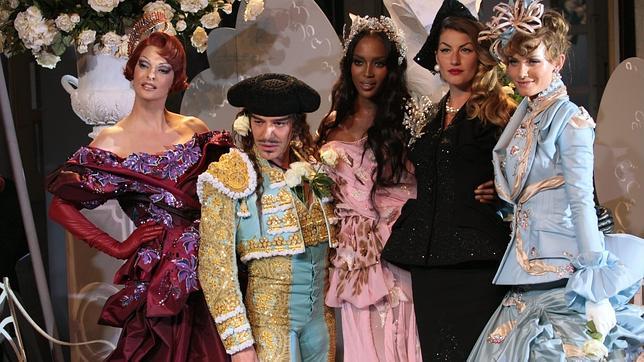
Zara calls its collaboration with John Galliano an act of democratization. The press repeats it without question, but a look at the price sheet is enough to see the word doesn’t hold: the collection runs from $30 to $999. That’s not expanded access — it’s the same pricing architecture as any luxury house, just dressed in the wrong logo for an average consumer who falls outside the range.
The entry piece, at $30, is what holds up the entire marketing narrative. It’s the proof trotted out whenever someone asks, “isn’t this good for people?” But that entry piece isn’t Galliano in his real expression — it’s the minimal gesture that lets the accessibility narrative hold while the piece that actually carries his signature, likely hovering around $999, stays out of reach for Zara’s average shopper, who spends between $40 and $100 on a garment. The democratization here is one of entry, not of substance. What’s democratized is proximity to the name, not access to the vision — and that’s exactly where the data kills the narrative.
Social media has already reacted — but for the wrong reason. The viral complaint isn’t about the narrative, it’s about quality: according to Inc. (inc.com), one Instagram comment described the collection as “a bunch of rags and cheap fabric put together with hot glue for a photo shoot,” while TikTok users have called it overpriced for the materials used. That’s a fair critique, but it stays on the surface. The real question isn’t whether the fabric feels expensive — it’s whether the story being sold around the price is true.
Add to this another “problem” less discussed but more structural: this isn’t a capsule, it’s a two-year deal, with collections dropping every six months. Every relevant collaboration in recent retail history — Comme des Garçons x H&M, Balmain x H&M, even Margiela x H&M — has relied on the same mechanism: temporal scarcity. A moment. A deadline. A reason for someone to line up at 6am. That scarcity is what turns a collaboration into a cultural event instead of a catalog product.
Zara just eliminated that variable. By turning “Galliano x Zara” into a continuous two-year relationship, it transforms what should have been a landmark event into a product vertical — one more category, like “Zara Studio” or “Zara Woman,” just borrowing a couturier’s name for the first season of hype. By the third or fourth drop, no one will be lining up. It’ll just be there, in stock, restocking like any other line. The genericness doesn’t come from bad design — it comes from the format itself killing the one condition that made the collaboration valuable: exceptionality.
So the dystopian part isn’t that Zara is selling cheap clothes inspired by a couturier — that’s happened before, and it will happen again. The dystopian part is the story built around it: that this is progress, that this is democratized access, that this is the new way to build fashion, when in reality it’s a double-edged operation — it keeps prices high where it matters (the piece that defines the collection) and dilutes scarcity where it also matters (over time). The consumer believes they’re accessing something once denied to them, when in reality they’re only accessing the entry-level version of a story that’s still protecting its real value — the name, the expensive piece, the symbolic exclusivity — somewhere else.
The question that should linger isn’t whether Galliano “sold out” his name. It’s more uncomfortable than that: if this is the model the industry is validating — discursive accessibility, real exclusivity left intact, and scarcity replaced by a permanent catalog — what’s left for the next couturier who wants to build something that’s truly scarce, truly theirs, and truly lasts?
Scarcity isn’t luxury nostalgia — it’s the last variable fashion has left to keep meaning anything at all.
By Aries Rivera


Leave a comment