
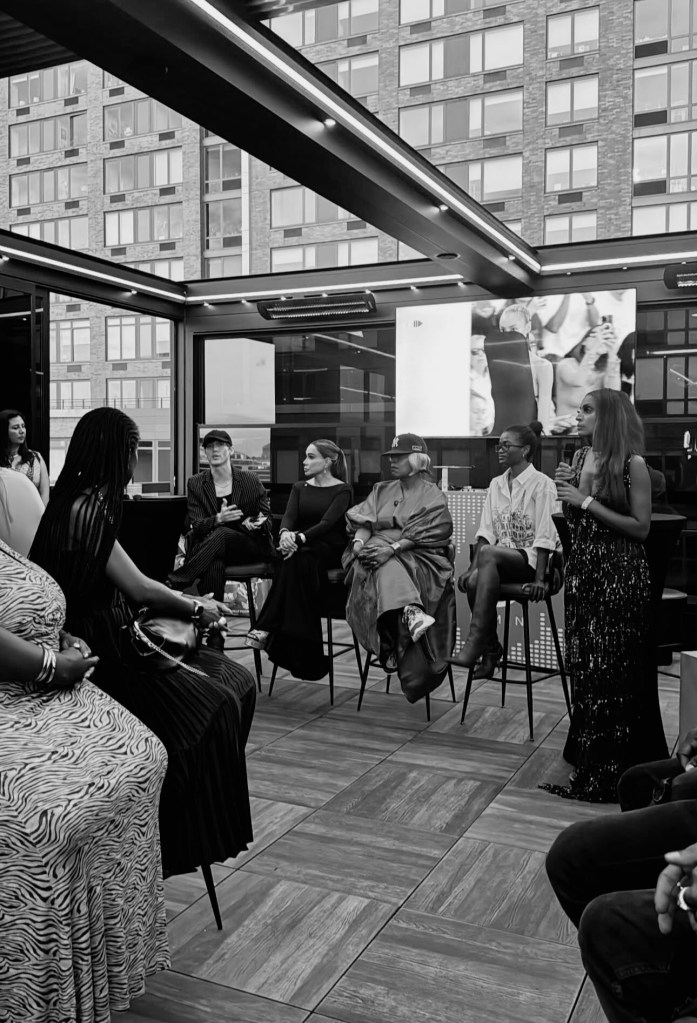
Fashion week conversations tend to default to two registers: aesthetics or hype. “Insulating Manhattan: Sustainability and Supply Chain Protection,” staged as part of Fashion Week United’s September program, deliberately avoided both. The panel — Aries Rivera (Chief Operating Officer, Fashion Week United), journalist Darralynn Hutson, Samira Salifu (Co-Founder & CEO of Masira), and Zaidy Mora Quintero (President, Colmundo / Colmundo Radio, and Women Leadership & Global Impact Honoree at the 2026 New York Fashion Awards) — brought together editorial, technology and production perspectives around a harder question than what a designer chose to send down a runway: what happens to that runway’s supply chain when the systems behind it are neither transparent nor resilient.
The conversation organized itself around three fault lines.
Inventory governance versus AI engines. As recommendation and forecasting systems take on more of the decision-making that buyers and merchandisers used to own outright, the panel pressed on a question the industry has been slow to answer directly: who is accountable when an algorithm’s demand forecast is wrong at scale? Overproduction has always been fashion’s quiet liability. The addition of AI-driven forecasting does not automatically solve that liability — it can just as easily launder it, distributing responsibility across a system opaque enough that no single actor has to own the miscalculation.
Supply chain resilience. The last several years have made clear that a fashion brand’s most consequential decisions are rarely made on a mood board — they are made in shipping contracts, factory relationships and material sourcing agreements negotiated months or years in advance. The panel argued that resilience is not a crisis-response capability bolted on after a disruption; it has to be underwritten the same way a creative vision is — deliberately and before it is tested.
Structural sustainability versus cosmetic marketing. Perhaps the sharpest thread of the afternoon was the distinction between sustainability as an operating discipline and sustainability as a communications strategy. A capsule collection made from recycled fiber is not, on its own, evidence of a resilient or responsible supply chain — it can coexist comfortably with the same overproduction and opacity the rest of the business runs on. The panel’s throughline was that the industry has gotten fluent in the vocabulary of sustainability well ahead of the operational discipline required to earn it.
None of these are new anxieties in fashion. What made the conversation useful was refusing to let them stay abstract — treating supply chain governance as a design problem with the same rigor an editor would apply to a collection review.
That same afternoon, the panel was paired with a small showcase of independent brands — a deliberate choice, not a scheduling convenience. Inside a week defined by scale and noise, the showcase argued for the opposite: a curated audience small enough to actually look, for designers who are otherwise competing for attention against hundreds of other names on the official calendar. The mission behind it extends beyond the panel itself — bringing in designers from different parts of the world who understand luxury and scarcity not as marketing language, but through their own hands, built from a personal, artisanal relationship to craft rather than an inherited one. That is a harder thing to stage than a runway show, and arguably a more honest one: it puts the panel’s argument about structural versus cosmetic sustainability into practice before the conversation about it even started.
The following night, Fashion Week United’s runway presentation at Rolls-Royce Cars Manhattan on Eleventh Avenue served, deliberately or not, as a kind of applied footnote to both. Staging a runway show inside a working automotive showroom is its own small argument about production: it borrows infrastructure instead of building disposable sets and it puts a fashion audience inside a space built around durability and engineering rather than spectacle for its own sake. The lineup — Diana Mahrach, Alonso Máximo, Anmol Handa, and Giannina Azar — was introduced not just as names but as a working cross-section of where independent fashion production currently sits: designers based across the United States, Mexico, Canada and the Dominican Republic, each building from a distinctly hands-on, personal relationship to craft rather than an inherited or purely commercial one. That range was proof that the panel’s conversation the night before was not theoretical.
Taken together, the panel and the show made the same point from two directions: the industry’s credibility problem is not a messaging problem. It is a systems problem. Editors and executives can continue writing convincing copy about circularity and craftsmanship, but the harder, less photogenic work — inventory discipline, supply chain transparency, decisions made months before a single look is fitted — is what will actually determine which brands survive the next disruption and which ones simply talked about surviving it.
By Aries Rivera / Founder, The Aries Perspective


Leave a comment